
The EU's tobacco rules asked Estonia for one thing. Estonia did three. Then the government's own tax receipts recorded exactly what happened next — and exactly what reversed it.
Analysis · 8 June 2026
By Ingmar Kurg · NNA Smokefree Estonia
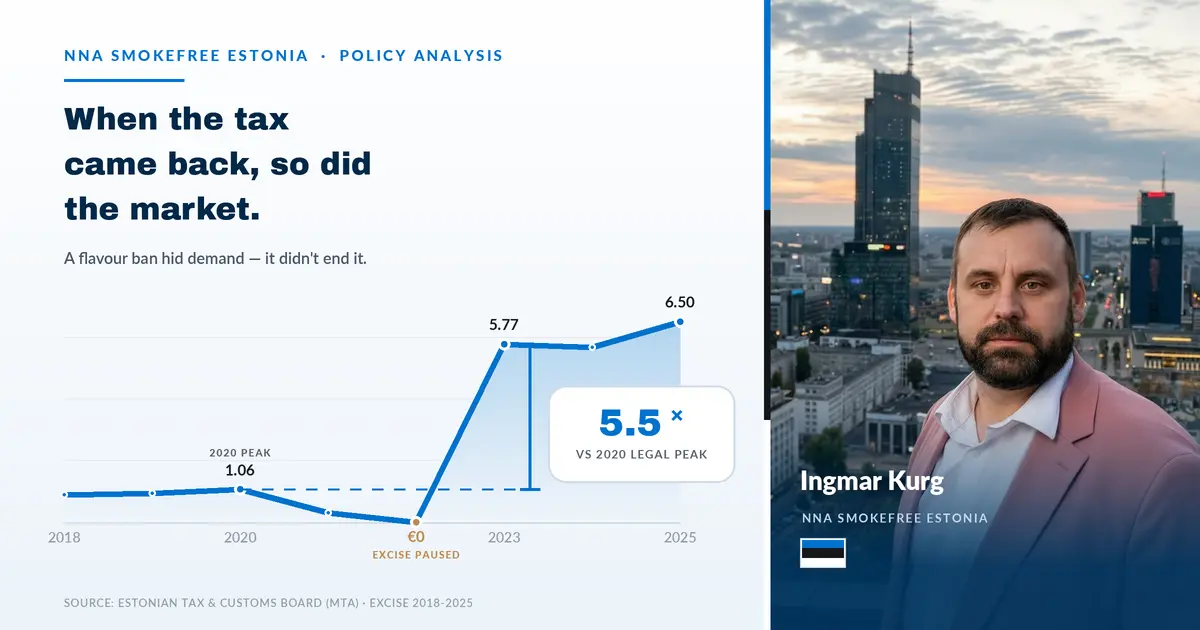
There is a comparison buried in the spreadsheets of the Estonian Tax and Customs Board that ought to be read into the record at every TPD3 working-group meeting in Brussels. In 2020 — after two years of a national e-liquid tax and a ban on every flavour but tobacco — the most excise Estonia managed to collect on nicotine e-liquid in a whole year was €1,055,711. In 2023, with that same tax back in force but menthol legal again and the trade coaxed back above ground, the figure was €5,774,902[6] — more than five times higher. The tax was the same. The product was the same. What changed was how much of the market the inspector could actually see.
It is tempting to point instead at 2022, when the recorded excise was exactly €0 — but on its own that figure proves nothing. Estonia had suspended the tax outright for 21 months, and a zero rate collects nothing no matter how much people buy. The honest signal is not the gap; it is the height of the legal market on either side of it. Before the suspension the taxed channel never cleared much above a million euros a year; once the tax returned and menthol was legal again, that same channel was suddenly five to six times larger. The demand had been there all along — the flavour ban had simply pushed most of it into a cross-border and black market that, by Estonia’s own estimates, accounted for 62–80% of the volume.
Estonia is small, but for harm-reduction policy it is the closest thing Europe has to a controlled experiment. Over seven years it switched a national e-liquid excise on, then off, then on again; it banned every flavour except tobacco, then re-permitted menthol; and at each step the government kept a meticulous, accrual-based ledger of every euro of excise it collected[7]. Those receipts measure only the legal, taxed market. So when the figure collapses while people are demonstrably still vaping, the receipts are telling you not that the market vanished — but that it moved somewhere the tax inspector could not follow.
This is the story the data tells, with the caveats stated plainly throughout. As the European Commission's 2025 tobacco-tax recast advances and a long-delayed third Tobacco Products Directive is drafted, the same instincts that produced Estonia's mistake are now pointed at the whole continent. Estonia has already run the test. The least Brussels could do is read the result.
The EU asked for one thing. Estonia did three.
The EU's second Tobacco Products Directive (TPD2) became applicable across the Union on 20 May 2016[8]. For e-cigarettes it set a clear, harmonised baseline: a maximum nicotine strength of 20 mg/ml, refill containers no larger than 10 ml, tanks and cartridges capped at 2 ml, mandatory product notification, health and composition warnings, child-resistant and tamper-evident packaging, and ingredient disclosure[9]. Those were the obligations. Every member state had to meet them.
What TPD2 conspicuously did not require was any ban on e-cigarette flavours. The directive's characterising-flavour prohibition applies only to cigarettes and roll-your-own tobacco; e-liquid flavour policy was deliberately left to national governments[10]. The EU-wide menthol ban that took effect on 20 May 2020 likewise covered cigarettes, not vaping products[11]. On flavours, Brussels asked Estonia for nothing.
Estonia went much further on its own initiative — the textbook definition of gold-plating, where a state piles national restrictions on top of an EU floor. It did three things the EU never demanded:
One: a national e-liquid excise. From 1 January 2018, Estonia's domestic excise act (ATKEAS) imposed €0.20 per millilitre on e-liquid, with and without nicotine alike[1][12]. Two: a tobacco-only flavour ban. A national amendment to the Tobacco Act, in force on 1 July 2019 (the bill passed in June — the often-quoted "June" date is the passage, not entry into force), made every flavour except tobacco illegal, and banned online sales in the same stroke[2]. Three: that online-sales ban, which removed the most age-verifiable, traceable retail channel that existed.
To be precise about scale: as of 2024, only 6 of the EU's 27 member states had banned e-cigarette flavours[13]. Estonia did not follow a European consensus. It joined a minority — and then went looking for the consequences in its own tax data.
What the tax receipts prove
Because the figures in Chart 1 are accrual-based government receipts rather than survey estimates or industry guesses, they carry an unusual evidentiary weight. They are not what people say they bought; they are what the state actually taxed. Read against the legislative calendar — which is exactly how NNA Smokefree Estonia has read them — they form a tight, dated chain of cause and effect.
The market didn't disappear — it went underground
From 2018 to 2020, with the excise in force and most flavours banned, the legal nicotine e-liquid market hovered around a million euros of excise a year: €893,028 in 2018, €942,773 in 2019, and a peak of €1,055,711 in 2020[6]. That €1.06M was the most the legal channel ever delivered under the flavour ban. It was also, by every contemporaneous account, a small fraction of what Estonians were actually consuming.
The figure cited throughout Estonia's own policy debate — repeated by MPs on the floor of the Estonian Parliament and in the December 2020 decision to pause the excise — was stark.
„Hinnanguliselt 62–80% Eesti e-vedeliku turu mahust moodustavad isesegatud, üle piiri toodud või salaturult ostetud e-vedelikud.“
“An estimated 62–80% of the volume of Estonia's e-liquid market consists of self-mixed, cross-border or black-market e-liquids.”
— the estimate that framed Estonia's policy debate (NNA / Vaping Post, 2021)[5]
That 62–80% should be read for what it is: an estimate used in the political debate, not a measured customs figure. It sits alongside two other numbers with quite different provenance, and the honest thing is to keep them apart rather than blend them into a single false precision. Separately, the retailers' association (ENEL) put the black market at around 60%, derived from monitoring how much collected e-cigarette waste was banned flavoured product — an industry estimate, not a study[14]. And NNA Smokefree Estonia's own surveys, in their worst years, recorded a peak as high as 79% of users sourcing outside the legal channel, a figure that combines black-market buying with product brought from abroad. Three methods, three vantage points, one consistent message: the legal market the tax could see was a minority of the real one.
The pause proved it
If the €1.06M legal market had been the whole market, then removing the tax and re-permitting menthol should have changed the level only modestly. Instead it changed it by a multiple. After the excise resumed on 1 January 2023 — by which point menthol had been legal again since May 2020 — legal excise revenue did not edge up. It leapt to €5,774,902, settled at €5.66M in 2024, and climbed to €6.50M in 2025[6].
Here the honest framing matters, because it is where overclaiming would get caught. The 2022-to-2023 jump from €0 to €5.77M cannot be attributed purely to flavours: a zero rate collects nothing whatever the flavour rules, so part of that leap is simply the tax being switched back on. The clean, defensible flavour comparison holds the tax constant and compares two years in which excise was collected: 2020, flavours banned, legal market ≈€1.06M; against 2023, menthol legal again, legal market ≈€5.77M — a factor of 5.47, call it 5.5×[6]. Measured against the 2018–2020 legal average of €963,837 it is roughly 6×; by 2025 the legal market stands at more than 6× the 2020 peak. Holding "excise collected" constant, legalising menthol and bringing the trade back above ground multiplied the state's taxed e-liquid market by between five and six times.
A transparent estimate — how big was the black market, and how much shrank?
The revenue curve shows money recovered; the deeper question is how much volume moved out of the illicit channel and back onto regulated shelves. The following is a theoretical estimate with stated assumptions, not a measured customs fact — and it should be read as such.
Assumptions: real consumption was stable or rising; revenue tracks volume at a roughly constant rate (the 2018–2020 rate was €0.20/ml; the resumed-2023 per-ml rate is not on the official MTA pages, so the 2023-vs-2020 figure is a volume multiple only if the rate held, and the post-2025 rise to €0.22/ml makes later years revenue, not volume); and the legal market that reappeared is mostly former illicit demand returning, not brand-new users.
Two routes bracket it. The contemporaneous ~60% black-market estimate puts the legal channel at about 40% of consumption during the ban — an illicit channel roughly 1.5× the legal volume. From the volume side, the legal market grew about 5.5× from ban (2020) to reversal (2023); if the recovered market approximates the one that always existed, only about one-fifth of consumption sat on the legal channel during the ban — an illicit share near 80%. Together: a ban-era black market of roughly 60–80%, collapsing to a small fraction once buyers returned to legal shelves. The reversal pulled the equivalent of about 5.5× the legal volume back above ground — estimated, not measured to the litre.
The political architect of the pause understood precisely why the tax cut alone could not finish the job. Tarmo Kruusimäe, the Estonian Parliament member who drove the exemption, used a vivid image on the floor of parliament:
„Eesti e-sigareti must turg on nagu taburet püsinud neljal jalal — ülikõrge aktsiisimäär, maitsete keeld, e-kaubanduse keeld ja muud piirangud. Täna murrame salaturu taburetilt aktsiisi jala.“
“Estonia's e-cigarette black market has stood on four legs like a stool — an ultra-high excise rate, the flavour ban, the e-commerce ban and other restrictions. Today we break the excise leg off the black market's stool.”
— Tarmo Kruusimäe, MP, Estonian Parliament[15]
That is the single most important sentence in the Estonian story. The pause removed one leg — the tax — and the legal market surged. But three legs remained: the flavour ban (never repealed; only menthol was added, on 29 May 2020, and only because the EU's menthol-cigarette ban forced the issue[3]), the residue of the online-sales restriction, and the rest. The recovery was large precisely because one leg fell. Had the flavour leg fallen too, the data imply it would have been larger still.
Revenue never collapsed
The objection a finance ministry always raises against harm-reduction reform is that the treasury will lose money. Estonia's ledger refutes that fear directly. Total tobacco-excise revenue was €199,913,793 in 2018 and €260,171,756 in 2025 — and across the whole turbulent period it stayed inside a band of roughly €200–260M, never falling below its 2018 level[6]. (It was not perfectly monotonic — 2024 dipped slightly below 2023 — but it never broke down.) What changed was the composition.
The standout is nicotine pouches. From a part-year €889,900 when they first appeared in the data in 2019, pouch excise reached €11,983,838 in 2025 — roughly a 13.5× rise, enough to make pouches the second-largest tobacco-excise category after cigarettes (in 2025, pouches €12.0M, ahead of e-liquid at €6.5M and heated tobacco at €2.8M)[6]. Cigarettes' share of the total slid from 95.7% to 86.6%. The combustible product lost ground; the treasury did not. Estonians shifted toward lower-risk nicotine, and the state's revenue base broadened rather than shrank.
What Estonians actually did
The tax receipts establish what happened to the market. To establish what people did — and why — the strongest Estonian evidence comes from two consumer surveys, and it is important to be candid about their nature before quoting a single figure from them.
With that stated: the first survey, conducted by Agris Adamberg in spring 2018 (fieldwork 20 March–8 April, n=112), captured the moment the excise landed and the flavour ban loomed[16]. Flavour mattered to 95.5% of respondents. The excise had raised the average shelf price by 51.66% (up to 84.75% at one chain), and 37.5% said the price had risen too high to keep buying legally. Sixteen of the 112 — about 14% — said they would simply return to smoking. Thirty-seven of them — a third — said they would turn to the black market.
And the black market, the survey showed, was trivially easy to reach. As a test, the researcher posted a single request in a Facebook group:
„Esimene inimene reageeris 4 minutit peale eksperimendi algust… Kokku ilmnes 13 kasutajat ja ajaliselt kulus kokku 10,5 minutit.“
“The first person responded 4 minutes after the experiment began… In total 13 sellers surfaced, taking 10.5 minutes in all.”
— the Facebook black-market test; one seller offered liquid at up to 100 mg/ml — five times the 20 mg/ml legal cap (Adamberg, 2018)[16]
Four minutes to the first seller; thirteen sellers inside eleven minutes; one of them offering nicotine at five times the legal strength. That is the alternative supply chain a flavour ban hands to consumers, fully formed and instant.
NNA Smokefree Estonia's flagship 2021 survey (fieldwork December 2020–March 2021, n=603, of whom 567 e-cigarette users) measured what users were actually doing two years into the ban[17]. The most telling finding is what they had learned to make for themselves: 58% had bought e-liquid components separately and mixed their own liquid at home — exactly the workaround a tobacco-only shelf forces. Only 37% were buying finished, legal e-liquid; 26% sourced from a friend or the black market; 19% bought across the border, where Latvia's excise on the same product was roughly eight times lower[5].
But the figure that should weigh most heavily on any legislator is not a sourcing channel. It is a relapse.
„7% endistest e-sigareti kasutajatest tunnistas, et maitsekeelu järel hakkasid nad taas suitsetama.“
“7% of former e-cigarette users admitted that after the flavour ban they began smoking again.”
— NNA Suitsuvaba Eesti survey, 2021 (the human cost)[17]
This is not a hypothetical, and that is what makes it the strongest causal-adjacent datapoint in the entire Estonian record. It is not "would you," as in 2018; it is reported past behaviour after the real 2019 ban. Seven percent of people who had successfully switched away from cigarettes went back to them — not despite the flavour ban, but, by their own account, because of it. A policy sold as protecting health produced, for these respondents, the precise opposite. (For context, the same survey found 60% reported their health had improved after switching to vaping in the first place.)
A black market with no quality control
A legal e-liquid sold in Estonia is capped at 20 mg/ml, notified to the regulator, ingredient-disclosed, and child-resistant by law — the TPD2 baseline doing its job. A flavour ban does not abolish demand for flavour; it abolishes the regulated supply of it, and hands the consumer to a market with none of those guarantees.
The evidence of what that market sells is not reassuring. Estonian black-market sellers in the 2018 test offered liquid at up to 100 mg/ml — five times the legal cap[16]. And the pattern is European, not merely Estonian: in a single Brussels enforcement action, more than 12,000 illegal e-cigarettes were seized, some containing up to 2.5 times the EU nicotine limit[18]. And the contamination is documented, not hypothetical: illegal e-cigarettes have been found to contain lead and nickel above permitted limits, with other dangerous metals reported in unlawful devices[30]. Estonia's own enforcement record is candid about the limits of policing this: an interior minister conceded in the Estonian Parliament in January 2024 that there is no direct figure for the size of the illicit e-cigarette market[4] — which is precisely the problem with driving a product into a channel you cannot measure.
The harm-reduction logic is therefore the reverse of how flavour bans are usually sold. Shrinking the black market — as the 2023 reversal demonstrably did, on the receipts — does not merely recover tax. It returns buyers to age-verified retail, to notified products at the legal nicotine cap, and away from liquids that may contain five times the nicotine or heavy metals such as lead and nickel. The regulated 20 mg/ml product is the safer one. The ban's effect was to make it harder to get than the dangerous alternative.
Did it help anyone quit?
It would be easy, and dishonest, to claim that Estonia's flavour ban and excise drove smoking down. They did not — and the data forbids the claim. Estonia's smoking decline began before these measures and continued through and around them, so no honest reading can pin the trend on a single policy lever. The figures must also be quoted with their definitions intact, because daily and current smoking are different measures and blending them manufactures false reversals.
On the Estonian National Institute for Health Development survey's definition, daily smoking among Estonian adults fell from 26.0% in 2014 to 13.2% in 2024 — the lowest level on record (men 18.1%, women 9.7%)[19]. On the EU-comparable Eurobarometer definition, daily smoking stood at about 18% in 2020[20]. Both are real; neither is "the" number; and they should never be averaged. Adult daily vaping, meanwhile, was around 1.6% in 2020 — worth stating clearly because a widely circulated "30% vape daily" claim is a debunked misreading of a percentage-of-a-percentage, not a prevalence figure, and should not be used at all.
What can be said is narrower but defensible: over a decade, Estonian daily smoking roughly halved while combustible cigarettes were partly displaced by lower-risk products — a displacement the excise receipts in Chart 2 corroborate. The strongest causal-adjacent Estonian datapoint pointing the other way is the one already quoted: the 7% who relapsed after the flavour ban.
The honest counter-signal
None of this means vaping is harmless or that youth uptake is a non-issue. The most important caveat to any "it only helped" framing is a youth one: among 16–24-year-olds, daily vaping now appears to exceed daily smoking — around 10% vape daily against roughly 5% who smoke daily, on the Estonian National Institute for Health Development's 2024 reading. We flag this as "around" pending confirmation against the primary Estonian National Institute for Health Development age-band report, but the direction is the point: a serious THR position has to hold both truths at once — that vaping has helped many adults off cigarettes, and that youth daily vaping is now the higher of the two among the young. A flavour ban is a blunt instrument for that problem, and Estonia's data suggests it mostly relocated the adult market underground while doing little for the youth concern it claimed to address.
Estonia wasn't alone — and didn't learn
Estonia's experiment has since been re-run, with foreign data clearly labelled as such, in country after country — and the results rhyme. In the Netherlands, a flavour ban took effect in January 2024; youth vaping then roughly doubled, from 3.7% to 7.6%, while 31% of users turned to the black market and 27% bought abroad[21]. In Canada, provincial flavour limits were associated with a 9.6% increase in cigarette sales[22]. In California and San Francisco, a post-ban street sample found 97.9% of flavoured e-cigarette packs were illicit[23]. In France, the AIDUCE survey of some 40,000 vapers found more than half would turn to the black market or buy abroad, and a quarter said they would resume smoking[24]. A separate international cohort across Canada, England and the United States found about 82% of vapers opposed flavour bans and 17.1% said they would return to smoking if their flavours were removed — a foreign figure, peer-reviewed, and not to be confused with Estonia's own[25].
The instructive counter-example is Sweden, where parliament rejected a flavour ban by 177 votes to 126 and instead let lower-risk products compete. Sweden has the EU's lowest smoking rate — around 6.5% daily, low enough that the country declared itself effectively smoke-free in 2025 — achieved largely through the availability of snus and pouches, not their prohibition[26]. The contrast is the whole argument: the countries that banned flavours grew their black markets; the country that let safer products compete shrank its smoking rate to a level the prohibitionists can only theorise about.
Brussels is about to repeat it
This is not history. It is a live legislative agenda. On 16 July 2025 the European Commission adopted its recast of the Tobacco Taxation Directive, which for the first time would extend EU minimum excise duties to e-cigarettes, heated tobacco and nicotine pouches[27]. It is crucial to state plainly what this is and is not: it is a proposal, sent to the Council and Parliament, with application not expected before around 2028. It is not in force, and specific sub-claims about its scope should be checked against the legislative text rather than asserted[28]. But its direction is unmistakable — an EU-wide version of exactly the excise lever Estonia pulled, then had to release.
Running in parallel is the long-awaited revision of the Tobacco Products Directive, TPD3. Here the responsible thing is to resist the temptation to overstate. The proposal has been repeatedly delayed and is now expected around mid-2026, with negotiations stalled; any e-cigarette flavour limit within it is contested and speculative, not settled[29]. We do not know that TPD3 will restrict flavours. We do know that the option is on the table, that several member states are pushing for it, and that the Estonian and Dutch evidence about what such a restriction does is already on the record. The danger is not that Brussels will act in ignorance. It is that it will act in spite of the evidence.
The lesson
Return to Kruusimäe's four-legged stool. Estonia built its black market on four legs — the ultra-high excise, the flavour ban, the online-sales ban and the rest — and then, in 2021, sawed off one of them. The receipts recorded the result with a clarity no survey could match: the legal market came back above ground at five to six times the best the ban had ever delivered, the treasury's revenue base broadened rather than collapsed, and the data imply the equivalent of roughly 5.5× the legal volume was pulled out of an unregulated, age-unverified, sometimes-poisoned supply chain — a theoretical estimate that depends on the rate being unchanged, not a litre-level measurement — and back onto notified, capped, child-resistant shelves. Three legs still stand — the flavour ban among them — which is the measure of how much more there is to recover.
For the EU the lesson is not "never regulate." Estonia met every TPD2 obligation, and those obligations — the 20 mg/ml cap, the warnings, the child-locks — are the framework that makes the legal product the safer one. The lesson is narrower and harder: the marginal national restrictions Estonia bolted on top of that framework did not suppress consumption; they relocated it, enriched smugglers, and pushed a measurable share of successful quitters back to the most dangerous product on the market. Estonia has paid for that knowledge already, in tax revenue forgone and in people returned to cigarettes. The data is public, dated, and government-issued. Brussels does not have to run the experiment again to learn the answer. It only has to read Estonia's receipts.
Read more from NNA Smokefree Estonia:
- NNA Smokefree Estonia commends Estonia’s decision to suspend e-liquid excise duty
- Smokeless Tobacco Products User Survey 2022
Sources
- Estonia introduces e-liquid excise (ATKEAS), €0.20/ml, 1 January 2018. NNA — Eesti peatab e-vedeliku aktsiisi kogumise; Vapor Products Tax — Estonia.
- E-liquid flavour ban (tobacco only) + online-sales ban in force 1 July 2019. Sotsiaalministeerium — Juulist jõustuvad tubakaseaduse muudatused; Võrumaa Teataja.
- Menthol e-liquids re-permitted, in force 29 May 2020 (flavour ban itself not repealed). Riigi Teataja, RT I, 19.05.2020, 1; Estonian Parliament bill 9 SE; Kaubandus.ee.
- Interior Minister Läänemets, Estonian Parliament, 15 January 2024 — no direct figure exists for the size of the illicit e-cigarette market. NNA #293 — NNA.
- "An estimated 62–80% of the e-liquid market is self-mixed, cross-border or black-market"; Latvia ~8× lower excise. NNA #145; Vaping Post (15 Apr 2021).
- Estonian Tax and Customs Board (Maksu- ja Tolliamet, MTA) — accrual-based tobacco-excise reports 2016–2025 ("Korrigeeritud 20.jaan.26") and cigarette-quantity reports.
- MTA accrual ("tekkepõhine") methodology — measures legal, tax-paid revenue and volumes only.
- TPD2 (Directive 2014/40/EU) applicable EU-wide from 20 May 2016. European Commission.
- TPD2 e-cigarette baseline (20 mg/ml, ≤10 ml refill, ≤2 ml tank/cartridge, notification, warnings, child-resistant packaging). European Commission — E-cigarettes.
- TPD2 characterising-flavour ban applies to cigarettes and roll-your-own only; e-cigarette flavours left to member states. PMC; Population Medicine.
- EU-wide menthol-cigarette ban from 20 May 2020 (cigarettes/RYO only). ASH; ENSP.
- ETHRA — Estonia takes the first steps towards recognising tobacco harm reduction (flavour ban + €0.20/ml → surge in cross-border trade).
- Only 6 of 27 EU states had banned e-cigarette flavours as of 2024. E-cigarette restrictions & flavour bans in Europe (overview).
- ~60% black-market estimate (retailer waste monitoring, ENEL / Eesti Nikotiinitoodete Edasimüüjate Liit) — an industry estimate, not a study. e-liit.ee.
- Excise-pause law passed 17 December 2020 (53 MPs); Tarmo Kruusimäe "four-legged stool" remarks. ERR; EMTA — excise-duty exemption for e-liquids ends.
- Adamberg, A. (2018), bachelor’s thesis Alternatiivsete tubakatoodete aktsiisi mõju tubakaturule, n=112, fieldwork 20 March–8 April 2018 (flavour 95.5%; price +51.66%; 37.5% priced out; Facebook black-market test; up to 100 mg/ml; 76.79% health improved). NNA #17 — Lõputöö: alternatiivsete tubakatoodete aktsiisi mõju tubakaturule.
- NNA Suitsuvaba Eesti flagship survey, fieldwork 3 December 2020–7 March 2021, n=603 (567 e-cig users, 72% men): self-mixed 58%; finished legal 37%; friend/black market 26%; cross-border 19%; 7% ex-vapers relapsed to smoking; 60% health improved. NNA #172/#173/#174.
- Brussels: 12,000+ illegal e-cigarettes seized, some up to 2.5× the nicotine limit. NNA #324. Estonian black-market liquids up to 100 mg/ml.
- Estonian National Institute for Health Development — daily smoking among adults 26.0% (2014) → 13.2% (2024), lowest ever (men 18.1%, women 9.7%). Tervise Arengu Instituut.
- Eurobarometer 2020 — Estonia ~18% daily smokers (definition differs from the Estonian National Institute for Health Development). Adult daily vaping ~1.6% (2020). NNA #157 / #251 (the "30% daily" figure is a debunked misread; real daily vaping 1.6%).
- Netherlands flavour ban (Jan 2024): youth vaping 3.7% → 7.6%; 31% black market, 27% abroad. Prohibition Does Not Work; NNA #388.
- Canada — provincial flavour limits associated with +9.6% cigarette sales. NNA #374 (Addictive/SSRN).
- California/San Francisco — post-ban street sample 97.9% flavoured e-cigarette packs (illicit). NNA #284.
- France — AIDUCE survey, n=40,000: >50% would turn to black market/abroad; 25% would resume smoking. NNA #287.
- Gravely et al. (ITC, Canada/England/USA): ~82% opposed flavour bans; 17.1% would return to smoking. PMC (DOI 10.1016/j.addbeh.2021.107152); NNA #209. (Foreign data — not Estonian.)
- Sweden — parliament rejected a flavour ban 177–126; ~6.5% daily smoking, declared smoke-free 2025 via snus/pouches. NNA #236; NORMO 2025 / Snusforumet.
- EU Tobacco Taxation Directive recast — Commission proposal adopted 16 July 2025 (extends minimum excise to e-cigs, heated tobacco, pouches). European Commission.
- TED recast legislative text (scope to be verified against the proposal itself). EUR-Lex 52025PC0580.
- TPD3 — pre-draft, expected ~mid-2026 (delayed, negotiations stalled); any flavour limit contested/speculative. ECigIntelligence; Ecigator — TPD3.
- Illegal e-cigarettes found to contain lead and nickel above permitted limits; the BBC has reported other dangerous metals in unlawful devices. NNA #264 — Illegaalsetes e-sigarettides tuvastati lubatust rohkem pliid ja niklit; NNA #317 — BBC: ebaseaduslikest e-sigarettidest leiti ohtlikke metalle.
© New Nicotine Alliance. All quantitative figures trace to official Estonian Tax and Customs Board (MTA) excise receipts, 2016–2025, and to the named consumer surveys. Survey provenance is disclosed in the text. British/EU English.